Memory, power and sovereignty: how the German French relationship reveals the new geography of power.
Since 1945, Europeans have sought to tame power. Over the past decade, power itself begun to redefine the terms of European integration. The sovereignty that is taking shape in the 21st century is no longer simply a matter of producing everything oneself. It is increasingly a matter of governing the public and private producers of power that determine a substantial share of strategic capabilities.
A remark attributed to French Academician François Mauriac[1], captures something of the peculiar nature of the German Franch couple: I love so much Germany that I am delighted there are two of them[2]. The British historian Julian Jackson[3] reports, moreover[4], that Charles De Gaulle regarded the Soviet concerns about Germany’s ambitions -including its nuclear ones- as legitimate, even a few years after signing the Élysée Treaty[5].
The Franco-German partnership, then, was not born of trust[6]. It was born of a desire to contain a German power whose return both sides feared, albeit for different reasons. For more than six decades, that mistrust was tamed by strong states, institutions and a strategic balance. It is that architecture which is now beginning to wobble.
I/-An earthquake in three aftershocks
The crisis of the Franco-German partnership[7] is no accident. It’s the third aftershock of the same earthquake, now 75 years old.
The triggering event was not Franco-German. It was American in inspiration. NATO[8] was created in 1949, amid mounting confrontations with the Soviet Union (USSR). The Korean war[9] in 1950[10] accelerated the view that a German military contribution was indispensable to Western defense. France, which had not chosen the timetable for Germany’s strategic reintegration, sought to contain it through European mechanisms. The Franco-German relationship was built around the lasting tension: to associate Germany with European power while preventing it from once again becoming a destabilizing force.
France’s 1st answer to the challenge of German rearmament had a name: The European Defense Community (EDC[11]). Between 1950 and 1954, le Pleven[12] Plan sought to allow a German military contribution without restoring an autonomous national army, by integrating German contingents into a European structure. The failure of the EDC exposed a tension that would endure between the ambition of an autonomous European capability and the embedding of Western defense within the Atlantic framework.
That tension would reappear in different forms throughout the history of Franco-German cooperation.
The Élysée Treaty of 1963 belonged to a political logic of rapprochement; today’s programs for the Future Combat Air System (SCAF[13]) and the Main Ground Combat System (MGCS[14]) belong to an industrial and technological one. Yet, the same difficulty remains turning shared political intent into a genuine sharing of sovereign capabilities. The obstacle is no longer merely the state. It now lies in industrial ecosystems, critical technologies and control of value chains.
The budgetary asymmetry, by contrast, has been reversed without resolving the original contradiction. For decades constrained by its constitutional framework and a culture of strategic restraint, Germany now has greater capacity to invest in defense than France, thanks to the Zeitenwende[15], a loosening of its fiscal constraints and a more favorable financial position. This rebalancing has not reduced tensions. It has moved them elsewhere.
Paris wants to preserve its technological lead and freedom of decision-making. Berlin now seeks to bring its revived economic and industrial weight to bear. The disagreements are less about stated objectives than about the allocation of competences, intellectual property and industrial benefits.
France’s response, meanwhile, follows an old strategic pattern. Whenever cooperative mechanisms appear incapable of guaranteeing a sovereign capability deemed essential, Paris tends to reinforce a national solution -or at least one under French control. The creation of France’s independent nuclear deterrent in the 1960s is the clearest example. Recent developments surrounding a transitional armored capability for the French army, alongside German work on a new generation of Leopard[16] tanks, reflect a similar logic. Faced with delays and uncertainty surrounding MGCS, each country is investing in a national or interim national solution, progressively weakening the political and industrial incentives to carry the joint program through to completion. This does not necessarily mean abandoning MGCS. It does, however, reduce its strategic centrality for its two principal partners.
The current crisis therefore does not reveal the temporary failure of a co-operative program. It exposes a deeper difficulty. Since the rearmament of the Federal Republic, French and German governments have succeeded in building a durable political interdependence but have found it much harder to construct stable industrial integration in the most sensitive areas of military sovereignty.
What is changing today is not so much the nature of the problem as where it is being expressed.
The decisive choices are no longer made exclusively by ministries or heads of government. They increasingly run through the industrial groups that control critical technologies, intellectual-property rights and supply chains. The tensions between Dassault Aviation and Airbus Defence and Space over FCAS, like those between KNDS and Rheinmetall over MGCS, illustrate the shift.
The power to block has not disappeared. It has moved towards industrial actors whose interests do not always coincide with the diplomatic compromises sought by governments.
II/-The threshold of power has risen
Previous Franco-German crises unfolded in a strategic environment in which the rules of the game were relatively stable. The Soviet threat, followed by American predominance, provided a clear frame of reference. The crisis now taking shape is different. It is occurring in a world in which the very conditions for exercising power have changed scale.
Strategic fragmentation is accelerating, technological gaps are widening, and the cost of entry into the ranks of powers capable of acting autonomously is rising rapidly.
Take fragmentation first. What distinguishes 2025-26 is not simply the multiplication of crises (a phenomenon familiar from history) but their simultaneity and interaction. High-intensity conventional war in Ukraine, military tensions around Taiwan, conflict in the Middle East, cyber operations, influence campaigns and sabotage of critical infrastructure now overlap.
A single power can combine military pressure, information operations, economic coercion and hybrid activity without crossing the threshold that would trigger general mobilization. War is becoming less a single confrontation between armies than a continuum of distributed actions taking place simultaneously across several domains.
The technological and industrial gap is even more striking
In space, the gap between Europe and the United States is no longer simply a matter of launch cadence. It reflects a divergence in industrial models. The European Union is expected to conduct roughly seven to eight Ariane 6[17] launches in 2026, one launch every six to seven weeks. SpaceX[18] alone is targeting between 140 and 175 launches, or several every week. The difference in cadence is therefore roughly 20 to 25 to one.
But the essential break lies elsewhere: in the industrial economics of launch.
The first stage of the Falcon 9 has demonstrated a reusability capability without equivalent, allowing an industrial asset to be progressively amortized rather than destroyed after every mission. Ariane 6, by contrast, remains an expendable launcher, with a substantial share of the industrial capital deployed and then lost on each flight.
The difference is therefore not merely quantitative. It concerns the very structure of costs, the speed of industrial learning and the ability to compound an advantage through successive iterations.
The divergence extends to space itself as a strategic domain. SpaceX now accounts for a dominant share of global orbital launches[19], while its Starlink[20] network, with more than 10,000 operational satellites, has become a commercial space infrastructure with growing civilian and military uses.
Europe’s IRIS² program[21], by contrast, is intended to provide sovereign secure-connectivity capabilities but remains in the deployment phase. The gap is therefore no longer simply about access to space. It concerns control of the infrastructures through which influence in space will be exercised.
Nuclear weapons confirm the same hierarchy.
The world’s nuclear arsenals remain concentrated in the hands of a small number of powers. The United States and Russia[22] alone possess almost 90% of the world’s nuclear weapons, with several thousand warheads each. China now constitutes a second strategic tier: its arsenal is estimated at around 600 warheads in 2026, up from roughly 350 in 2020, and is expanding rapidly, with a stated objective of at least 1,000 warheads by 2030.
France, with roughly 290 warheads, and Britain, with around 225, retain credible deterrent capabilities. But their weight remains limited compared with the three largest nuclear arsenals.
That hierarchy has also entered a period of greater uncertainty. The expiry of the New START treaty[23] between Washington and Moscow in February 2026, without a negotiated replacement, marked the end of the last major bilateral framework for limiting strategic arsenals.
Nuclear stability is no longer simply a matter of possessing weapons. It increasingly depends on the ability to maintain complex systems of command, intelligence, early warning and production.
The land domain tells a similar story.
Despite the rapid transformation of warfare, military mass remains strategically important. China fields roughly 6,800 main battle tanks, compared with about 4,600 for the United States. No European power comes close to those numbers on its own. France, the European Union’s leading military power in terms of overall capabilities, has roughly 264,000 active personnel, while China’s armed forces exceed two million (2,03).
The budgetary gap completes the picture.
In 2026, the United States is spending several hundred billion dollars more on defense than its principal competitors, with its budget potentially approaching or exceeding $900bn, depending on the accounting basis used. China follows with official defense spending of around $314bn, while Russia continues to devote an exceptional share of its economy to defense as the war in Ukraine continues.
Europe is now responding with a significant rearmament effort.
Germany[24] is targeting a major increase in military spending, to around $230bn from roughly $109bn today.
France is also planning a substantial increase, to around $145bn from $71bn. But this resurgence starts from a base that was long undersized and comes amid severe fiscal constraints: France’s public debt is around 112% of GDP, while demographic ageing and competing social demands are increasing.
European rearmament therefore does not immediately close the gap with the great powers. It mainly slows its widening.
The question is thus no longer simply one of a fragmented world. It is the new cost of entry into the club of powers capable of acting autonomously.
Mastering space, maintaining a complete defense-industrial base, sustaining a prolonged military effort, controlling critical technologies and preserving nuclear credibility now require financial, industrial and human resources that few states can assemble alone.
It is precisely this rising threshold of power that places Europe before its current paradox.
While Paris and Berlin negotiate the industrial division of a joint tank program whose entry into service remains years away, China is rapidly expanding its nuclear arsenal, and the United States continues to sustain a military effort greater than that of its principal competitors combined.
The dynamic is similar to what is happening in space. This is no longer merely a technological or commercial lag. It is a capability gap with direct implications for European security.
The Franco-German problem therefore does not stem from two completely opposed visions of power. It arises because two states are simultaneously trying to preserve national sovereignty within program explicitly designed to create a common European sovereignty.
FCAS and MGCS are not merely confronted by industrial disagreements.
They expose a deeper contradiction between the logic of national power and the ambition of European integration.
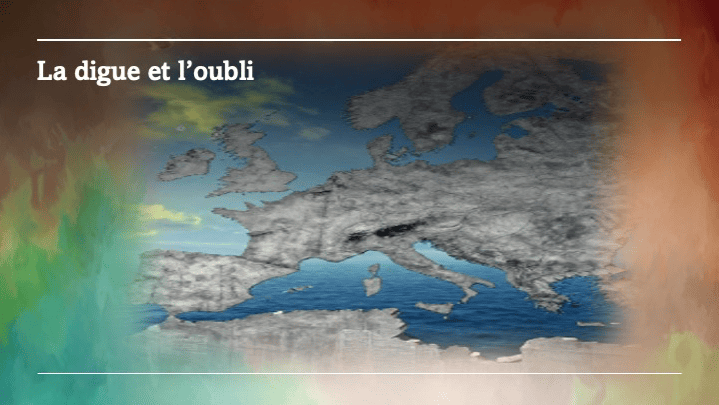
Interlude: The Dam and the Forgetting
The Franco-German partnership has never rested on institutions alone. It also rested on a living memory of the catastrophes that had befallen Europe in the 20th century.
For decades, that memory acted as an implicit political constraint. To seriously undermine the Franco-German relationship was to weaken the very legacy of reconciliation on which post-war Europe had been built.
That constraint is now changing.
As long as direct witnesses remain, memory remains embodied. Once they disappear, it becomes primarily historical. The memory does not vanish, but it gradually ceases to be carried by those who experienced the events themselves.
October 12th, 2021, was, in that respect, a symbolic date. With the death of Hubert Germain, the last surviving Companion of the Order of the Liberation[25] disappeared. The Second World War finally passed from the lived memory of France’s institutions into the realm of the archives.
The evolution is not identical on both sides of the Rhine.
In May 2020, 53% of French respondents said that the Second World War still concerned them today, compared with 34% of Germans. This difference obviously does not explain German rearmament by itself. It does, however, suggest that the weight of historical memory no longer bears on the political choices of the two countries with the same force.
The transition is even clearer among younger generations.
A study published by the Jean-Jaurès Foundation[26] in April 2026 shows that the great conflicts of the 20th century now belong to a past without direct witnesses. Memory has not disappeared. Its status has changed. As this reservoir of memory loses some of its force, industrial and strategic disagreements are increasingly judged in terms of national interests rather than their symbolic significance for European reconciliation.
The dam is not breaking. It is gradually becoming lower.
And with it is fading one of the informal constraints that had long contained Franco-German rivalry.
III/-When power leaves the state
The current Franco-German crisis reveals a transformation more profound than the failure of an arms program.
Since the middle of the 20th century, the state had remained the central actor in the production of power. It decided, financed, commanded and employed the principal military, industrial and technological instruments of sovereignty.
That architecture has not disappeared. But it is no longer exclusive.
An increasing share of strategic capabilities is now designed, financed or operated by private companies whose interests do not always coincide with those of the states that helped bring them into existence.
The state retains the monopoly of legitimate violence, in Max Weber’s[27] sense. What it no longer possesses exclusively are the material means of producing power.
Satellites, artificial intelligence, military software, digital infrastructure, critical components and intellectual property increasingly belong to economic actors capable of directly influencing governments’ strategic choices.
The question for the 21st century is therefore not whether the state will disappear. It is whether it can govern producers of power that have become partly autonomous.
Starlink is the most visible example.
Elon Musk’s satellite network is no longer merely a connectivity provider. It has become a de facto military infrastructure.
In 2022, the decision not to activate coverage off the coast of Crimea, for fear of escalation with Russia, demonstrated how a private commercial decision could directly alter the military options available to a state at war.
At the beginning of 2026, the suspension of Starlink access for Russian forces illustrated a further development: a private company can now affect the operational capabilities of a strategic adversary without a prior government decision.
The significance of this phenomenon goes beyond Elon Musk’s personality.
The structural problem is that some companies no longer merely supply equipment to states. They control capabilities on which states themselves depend to exercise power.
When a private provider can determine which operations a military actor is technically capable of conducting, the relationship is no longer purely commercial. It touches the very exercise of sovereignty[28].
The phenomenon is not confined to the relationship between companies and foreign powers. Networks can also come into tension with the state in which they were created.
In the United States, Elon Musk’s growing role in public-policy and defense debates has fueled questions about the boundary between private interest, political influence and national strategy.
The issue is not whether a company acts for or against a state. It is that it now pursues a logic of its own, capable of constraining public action.
The Franco-German case offers a subtler version of the same transformation because the industrial network and the state are, in theory, allies.
The Dassault-Airbus case shows that the question is no longer simply whether states depend on private companies. It is whether they can direct industrial actors that possess strategic interests of their own.
The FCAS episode is revealing of a change in the political order.
On April 22nd, 2026, Éric Trappier[29] announced the end of negotiations between Dassault Aviation and Airbus Defense and Space[30] over the New Generation Fighter (NGF[31]), the central component of the program. The announcement came after months of Franco-German mediation, as Paris and Berlin sought to preserve an industrial compromise[32].
Governments then had to respond to a decision taken at industrial level.
The traditional order had been reversed.
The state no longer always sets the timetable to which companies must conform. It must now accommodate their own constraints.
Dassault’s autonomy is not political in origin. It is commercial.
Between 2017 and 2026, the Rafale was sold to Egypt, Qatar, India, Greece, Croatia, the United Arab Emirates and Indonesia. Those contracts transformed Dassault into an autonomous export actor, capable of financing its own development and preserving a degree of independent decision-making.
The company is therefore not simply a national industrial champion. It has become an actor with an international commercial base.
It is this economic autonomy that generates political autonomy.
A company dependent on a state program remains subject to public decisions. A company capable of finding its own external markets gains greater room for maneuver.
The more commercially autonomous the firm, the more politically autonomous it becomes[33].
The central disagreement over FCAS is therefore not simply a clash of personalities or industrial cultures. It concerns control of a strategic asset: intellectual property.
Since 2019, the question of sharing technologies derived from the Rafale, including embedded software, flight-control laws, stealth architectures and decades of accumulated know-how, has been the principal point of friction.
For Dassault, these technologies are no longer simply French industrial patrimony. They represent a decisive competitive advantage in markets where Airbus Defense and Space can also be a competitor.
The two companies do not, however, possess the same degree of autonomy.
Airbus Defence and Space has built much of its future military strategy around European cooperation and access to major multinational program. Losing a leading role in FCAS would therefore directly affect its industrial ambitions.
The network does not escape the state uniformly. It escapes in proportion to its economic independence. The transformation is also visible in the very form of the dispute. Decisions that would once have belonged exclusively to governments are moving towards industrial executives. The public statements of Éric Trappier and Michael Schoellhorn[34], chief executive of Airbus Defence and Space, illustrate a new phenomenon: two corporate leaders openly debating the future of a program regarded as strategic by two European states.
Industrial negotiation is becoming a form of geopolitical negotiation.
Palantir represents the next stage in this evolution.
Starlink shows that a company can possess a strategic capability.
Dassault shows that an industrial firm can acquire significant autonomy of its own.
Palantir[35] goes further: it explicitly theorizes this new relationship between the company and power.
In April 2026, Alex Karp[36], Palantir’s chief executive, published a manifesto calling on Silicon Valley to reengage directly with Western defense.
His argument is that technology companies are not neutral suppliers. They have a political responsibility towards the states that made their development possible. This reverses the traditional relationship.
The company is no longer simply asking the state to fund innovation. It is claiming a role in defining strategic priorities.
The connection with Europe is direct.
Palantir established itself in Germany, in Frankfurt, in 2024 and entered into partnerships with the Bundeswehr[37] in the context of the Zeitenwende[38] launched after 2022.
German rearmament therefore increases the country’s own capabilities, but an increasing share of its military instruments also rests on American technological infrastructure.
Strategic autonomy can no longer be measured simply by possession of national equipment. It also depends on control of the technologies that make that equipment operational.
That is the real turning point.
Contemporary power is not leaving the state. It is leaving the state’s monopoly.
Governments remain the only actors capable of setting rules, mobilizing legitimate coercion and arbitrating between competing interests.
But they must now contend with private producers of power on whom they depend on to perform their own sovereign functions.
The challenge of the 21st century is therefore no longer to choose between market and state.
It is to determine how a democratic state and its private-sector actors -who now produce a critical share of the capabilities essential to its sovereignty and even its survival- can act ethically in the service of the common good.
IV/-The numbers behind an unprecedented concentration
Anduril provides the quantitative evidence of this shift.
The transformation of America’s defense-industrial base is not merely about the arrival of new players. It can now be measured in the extraordinary concentration of investment in defense technology.
In the latest documented budget cycle, three companies -SpaceX, Palantir and Anduril- accounted for most of the federal funding devoted to emerging defense technologies, receiving roughly $3.7bn out of $4.3bn committed, or about 84% of the federal envelope dedicated to defense technology.
This concentration reveals a paradox.
These companies remain marginal in the Pentagon’s overall spending. Yet they occupy a disproportionate position in the segments likely to shape future power: space, artificial intelligence, military software, autonomous systems and large-scale data processing.
Their combined market capitalization now exceeds that of America’s five traditional defense giants taken together, even though they account for only a fraction of the Pentagon’s conventional contracts.
The risk associated with this new architecture is clear.
Excessive concentration can create critical dependencies and even single points of failure.
The traditional industrial model itself faces serious constraints, including a labor shortfall estimated at almost 1.9 million workers and acquisition cycles that can last more than a decade.
The issue is therefore not to replace a public monopoly with a private one. It is to understand why the new players are advancing precisely where traditional structures are reaching their limits.
Anduril embodies this break with the old model.
Its advantage does not rest on a single technology, but on a different industrial method: short development cycles, initial private financing, a software-driven culture and rapid iteration.
Where major defense programs often rely on multiyear schedules subject to successive political decisions, Anduril operates according to a logic closer to that of the digital economy.
This difference in tempo is already changing the relationship between the state and its suppliers.
The Pentagon has had to adapt its own contracting methods, creating specialized teams -such as Deal Team Six[39]- capable of negotiating with companies originating in the technology sector.
The signal is significant.
The military bureaucracy is acknowledging that its traditional procedures are no longer sufficient when dealing with companies whose industrial rhythms are radically different.
The US Army’s NGC2[40] program illustrates the break.
For the first time, a young defense company is challenging an established player such as Lockheed Martin for a program potentially capable of equipping a major military unit.
The significance extends beyond the contract itself.
Strategic innovation no longer comes exclusively from industrial groups that have been established for generations.
Palantir and Anduril therefore represent the American culmination of the argument developed in this chapter: contemporary power belongs less to those with the largest structures than to those able to combine critical technology, private capital and national strategic objectives at speed.
The link with Europe is direct.
The partnership between Palantir and the Bundeswehr shows that German rearmament, however substantial, does not automatically translate into technological autonomy.
An increasing share of modern military capabilities depends on digital infrastructures whose control remains outside Europe.
The Franco-German problem therefore extends well beyond joint programs. It concerns the entire continuum between public sovereignty and private power.
On both sides of the Rhine, the issue is no longer simply how to produce more national equipment. It is who controls the technologies that make that equipment genuinely sovereign.
Conclusion: The Dam and the Forgetting
The Franco-German crisis is not a product of short-term circumstances. Its roots lie in the very conditions that shaped Europe’s reconstruction after 1945.
But it is more serious than its earlier aftershocks -the European Defence Community and then the Élysée Treaty- because it is occurring in an unprecedented environment: a fragmented world, marked by conflicts involving the major powers simultaneously, and by a widening gap between those powers and much of the rest of the world, including the European Union.
In this environment, power is not disappearing from the state. It is ceasing to be the state’s monopoly.
Private actors, often created or supported by states themselves, now control capabilities whose strategic importance goes well beyond their original economic purpose.
Starlink shows that a private infrastructure can influence the conduct of a war.
Dassault and Airbus show that Europe’s industrial power is now contested as much between companies as between governments.
Palantir and Anduril illustrate the emergence of a model in which technology, private capital and national ambition are being recombined into a new relationship between the firm and the state.
This evolution does not herald the disappearance of the state. On the contrary, it confirms its indispensable role.
The state remains the only legitimate political actor capable of arbitrating between states, between states and networks, or between competing networks.
But that function of arbitration is now being tested in domains where international law still assigns responsibility to states while an increasing share of the operational capabilities belongs to private actors whom governments control only imperfectly.
Space provides the clearest example.
States remain legally responsible for activities conducted under their jurisdiction even as an increasing share of the means required to exercise space power belongs to private companies.
The Franco-German case is therefore not simply a bilateral crisis.
It is the 1st visible theatre of an arbitration that will have to be repeated wherever power has split between the state and the network.
This transformation is becoming politically possible precisely as the last moral constraint that once made certain forms of decoupling unthinkable is disappearing: the living memory of war.
On October 12th, 2021, with the death of Hubert Germain, the last surviving Companion of the Liberation, the embodied transmission of the wartime experience of the Second World War came to an end.
His death does not, by itself, explain the strategic developments that followed.
But it marks a change of era.
The generation that still physically carried the memory of Europe’s war now belongs to history.
The Dam of memory has receded at precisely the moment when power is fragmenting between states and networks.
This is not merely a chronological coincidence.
Memory once constrained certain political possibilities. Its retreat now opens the way to others.
A study by the Foundation for Strategic Research[41] has pointed to the risk of a gradual retreat in Germany’s European commitment: a Germany increasingly oriented towards its national economic interests and external partnerships at the expense of a more integrated European ambition.
That scenario would represent a weakening of the European project rather than a genuine “Dexit”.
Tim O’Reilly[42], the publisher and influential observer of the digital economy, has argued that artificial intelligence should be seen not merely as a technological revolution but as a reflection of the organizations that produce it.
A company that concentrates power without adequate mechanisms of accountability does not merely build more capable machines. It embeds its own governance architecture in the systems it creates.
As he puts it: “The design of the company is a preview of the design of the machine”.
The warnings are therefore already there.
They resemble those signs found on mountain roads: Beware of falling rocks or Wild animals crossing.
Few motorists turn around when they see them. The road continues, and one has to keep moving.
But once the rock falls or the animal appears around the bend, it is too late to check whether the brakes are adequate.
The question is therefore no longer whether private networks of power will disappear.
They will not.
The question is whether, in Europe -and particularly within the Franco-German relationship- states will still be capable of constructing the counterweights needed to govern them.
The dam and the forgetting are not two parallel stories. They are the same story, told at two different scales.
Gingko Confidentiel. Daniel Alystair. With my thanks to SH and GC. August 15th, 2026. All rights reserved, ©./.
[1] Académie Française, François Mauriac (1885-1970) : https://www.academie-francaise.fr/les-immortels/francois-mauriac
[2] History of quotations : https://histoire-en-citations.fr/WP/mauriac-jaime-tellement-lallemagne-que-je-suis-ravi-quil-y-en-ait-deux/
[3] Julian Thimothy Jackson, British historian, professor of history, Queen Mary University of London, member of the prestigious British Academy and of the Royal Historical Society: https://legrandcontinent.eu/fr/p/julian-jackson/
[4] De Gaulle, a certain idea of France, Julian Jackson, Extraits) : « The next day, after De Gaulle presented his vision of Europe to Nixon Kissinger asked him how he would prevent Germany from dominating Europe he had juts described. De Gaulle answered: “By war”. What De Gaulle seems to have meant was that the Germans had aroused legitimate fears in the Soviet Union because they had not accepted the Oder-Neisse border drawn in 1945, and that they still had nuclear ambitions (P1174, 1175, 1189).
[5] Élysée Treaty: https://france-allemagne.fr/fr/le-couple-franco-allemand/historique/traites/traite-de-lelysee-22-janvier-1963
[6] Reconciliation was born out of strategic realism rather than spontaneous trust.
[7] Born in the sixties, the expression reflected a politically strong France in the face of a divided but economically ascending Germany. In 2026, this balance was reversed: Germany dominates economically alongside France, which nevertheless retains strategic power.
[8] NATO: https://www.nato.int/fr
[9] National geographic, publication of Erin Blakemore (June 25th, 2025) : The Korean war has (technically) never ended. Link: https://www.nationalgeographic.fr/histoire/geopolitique-guerres-la-guerre-de-coree-n-a-techniquement-jamais-pris-fin
[10] Chemins de mémoire: https://www.cheminsdememoire.gouv.fr/fr/1950-1953-le-bataillon-francais-de-l-onu-en-coree
[11] INA : In 1954, the failure of ECD (February 20th, 2025) : https://www.ina.fr/ina-eclaire-actu/communaute-europeenne-de-defense-1950-1952-1954
[13] European security (August 2nd, 2026) : https://european-security.com/scaf-le-divorce-est-consomme-safran-ferme-la-derniere-porte/
[14] Opex360 : https://www.opex360.com/2026/07/18/clap-de-fin-pour-le-char-franco-allemand-paris-et-berlin-reduisent-le-projet-mgcs-au-seul-combat-collaboratif/
[15] Statement of the Federal Chancelor Olaf Scholz (February 27th, 2022): https://www.bundesregierung.de/breg-fr/service/archives/déclaration-gouvernementale-du-chancelier-fédéral-2009510
[16] National Transitional Armored Capacity, CAPINT versus Léopard III (Opex360 : https://www.opex360.com/2026/04/08/le-mgcs-prenant-une-dizaine-dannees-de-retard-mme-vautrin-justifie-la-necessite-dun-char-intermediairemaire/, Metadefense : https://meta-defense.fr/2026/06/16/knds-retrait-france-mgcs/).
[18] SpaceX : https://www.spacex.com
[19] SpaceX accounts for nearly 40% of global orbital launches in 2026, more than what the rest of the world combined achieve 10 years ago.
[20] Starlink : https://starlink.com/fr?srsltid=AfmBOoqYLavlbmAvBLOha_XMnBUlne1uoljHcl8NFLmFudMc4gKeZROd
[22] Around 5 400 à 5 500 têtes côté russe, 5 100 à 5 200 côté américain.
[23] FRS : https://www.frstrategie.org/programmes/observatoire-de-la-dissuasion/expiration-traite-new-start-fin-une-epoque-2026
[24] Fondation Robert Schuman (May 21st, 2014) : Europe’s decline, a German story? (https://www.robert-schuman.eu/en/european-issues/750-europe-s-decline-a-german-story).
[25] Companion of the Ordre of the Libération: https://www.ordredelaliberation.fr/fr/les-femmes-et-les-hommes-compagnon-de-la-liberation
[26] Jean-Jaurès Foundation: https://www.jean-jaures.org
[27] Max Weber, German economist, sociologist and philosophe: https://www.larousse.fr/encyclopedie/personnage/Max_Weber/138958
[28] Foreign policy : https://foreignpolicy.com
[29] Éric Trappier (Dassault) : https://investor.3ds.com/fr/board-member/eric-trappier
[30] Airbus Defence and Space : https://www.airbus.com/fr/about-us/our-worldwide-presence/airbus-in-europe/airbus-en-france/airbus-defence-en-france
[31] La Dépêche : https://www.ladepeche.fr/2026/06/09/airbus-dassault-clap-de-fin-pour-le-projet-davion-de-combat-europeen-de-nouvelle-generation-13410258.php
[32] The “Lats chance” mediators, Laurent Collet-Billon on French side and Franck Haun on the German one, were responsible to for finding a compromise before April 18th, 2026.
[33] The singular position of Dassault Aviation illustrates a tension that is constitutive of the European defense industry. Its commercial autonomy, built in particular thanks to the Rafale, is a strategic asset: it preserves the mastery of critical skills and reinforces the operational credibility of the European industry. But this autonomy comes into tension mechanically with a logic àf industrial pooling, which implies an increased sharing of skills and responses. The debate is therefore not about the need to preserve or limit the autonomy of an industrial actor, but about Europe’s ability to organize cooperation between actors who already have sovereign capacities, in order to transform dispersed national capacities into collective power.
[34] Michael Schoellhorn : https://www.theofficialboard.fr/biographie/michael-schoellhorn-d9d69
[35] Palentir: https://www.palantir.com and https://ch.zonebourse.com/actualite-bourse/les-resultats-de-palantir-et-le-rebond-de-la-tech-soutiennent-les-contrats-a-terme-americains-avant-ce7f50deda8af32c
[36] Alex Karp : https://www.forbes.com/profile/alexander-karp/
[37] Bundeswehr : https://www.bundeswehr.de/en/
[38] Statement of Federal Chancellor Olaf Scholz (February 27th, 2022) : https://www.bundesregierung.de/breg-fr/service/archives/déclaration-gouvernementale-du-chancelier-fédéral-2009510
[39] Meta Defense : https://meta-defense.fr/2026/05/11/pentagone-cree-deal-team-six-negociations-armes/
[40] Lockheed Martin : https://www.lockheedmartin.com/en-us/products/next-generation-command-and-control.html
[41] FRS, May 21st, 2024: Europe’s decline, a German story ? (https://www.robert-schuman.eu/en/european-issues/750-europe-s-decline-a-german-story).
[42] The Economist: Tim O’Reilly, “By invitation” (June 25th, 2026, Page 13).

Comments0
Please log in to see or add a comment
Suggested Articles