From Paris 1 Panthéon-Sorbonne to AlUla: Carl Wozniczka-Brousse’s Journey
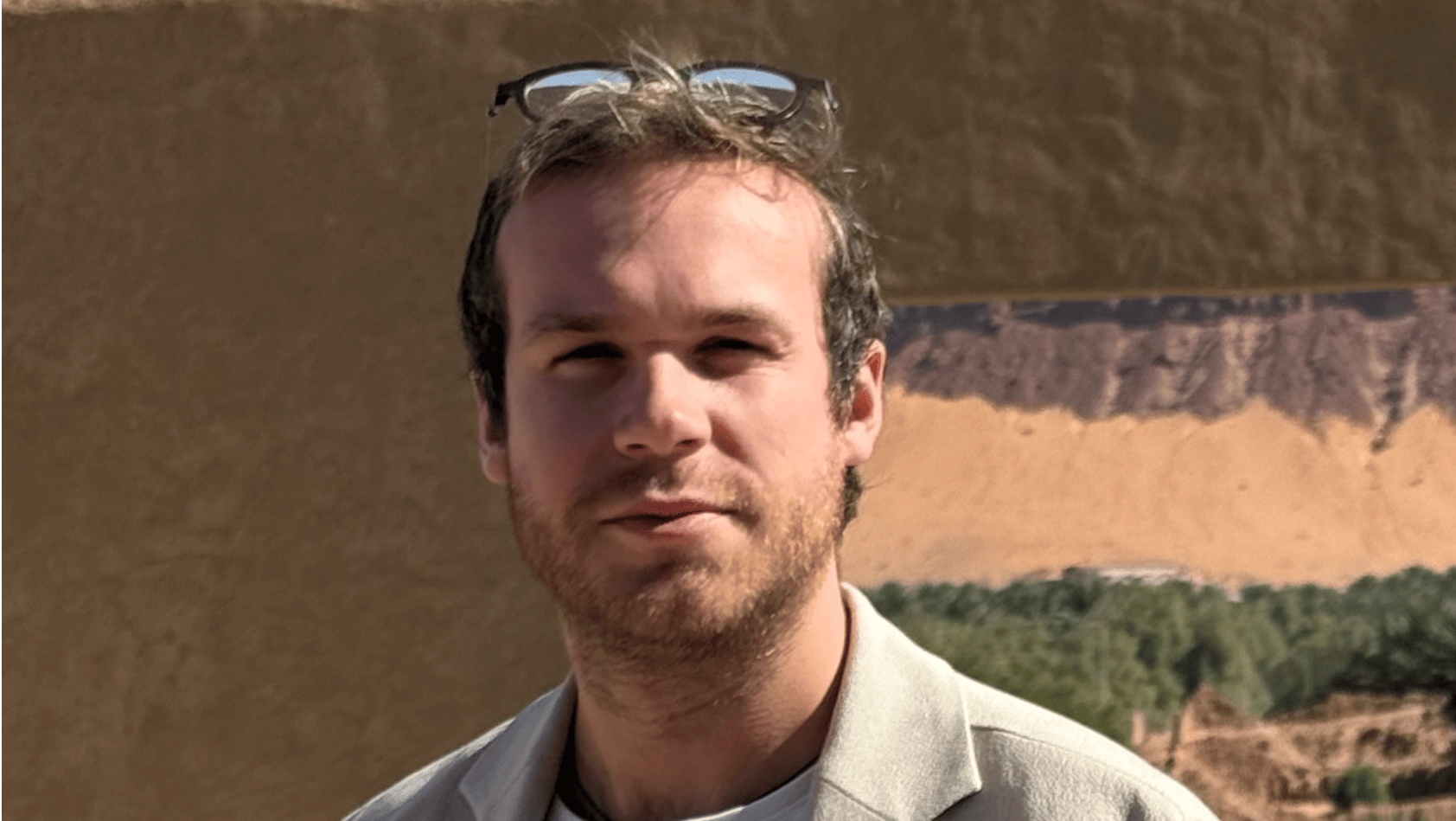
Upon arriving at Paris 1 Panthéon-Sorbonne in 2015 as a sophomore in the history program, Carl Wozniczka-Brousse discovered an academic environment characterized by student engagement and an openness to the world. Through Sorbonne-ONU (SONU), where he joined the “International Security and Defense” chapter, he gained an introduction to international relations, geopolitical issues, and defense matters. This experience helped shape his career goals: rather than simply commenting on international issues, he now wanted to play an active role in them.
His longstanding interest in the Arab world then guided his studies. After earning a master’s degree in contemporary history of Africa, the Maghreb, and the Middle East, he went on to complete a professional master’s degree in Africa-Middle East International Cooperation (CIAMO). In 2019, he spent six months in Palestine at Bir Zeit University as part of an Erasmus+ program. This experience left a deep impression on him, and he would recount it a few years later in his book Une vie derrière le mur. Récit d'un étudiant français en Palestine (A Life Behind the Wall: The Story of a French Student in Palestine), published by Éditions du Félin.
Upon his return, he completed a six-month internship at the French Embassy in Saudi Arabia, working in the political section, before joining the French Embassy in Bahrain as an international administrative volunteer. After two years focused on academic, scientific, and cultural issues, he joined the French Development Agency in AlUla in late 2022 as a training and education project manager.
Today, he works on developing the skills of the local population, particularly in the sectors of tourism, culture, equestrian sports, perfumery, and sports. From Paris 1 Panthéon-Sorbonne to Palestine, then from Riyadh to Bahrain, and now in AlUla, his career path has been guided by a common thread: a desire to better understand the Arab world in order to take concrete action there.
What memories do you have of your years at Paris 1 Panthéon-Sorbonne University?
The first memory that comes to mind is my first steps on the Tolbiac campus. I’m not from Paris—I’m from Amiens—and I had completed my first year of a bachelor’s degree in history in Lille. When I was accepted to Paris, I did some research on the university, and the first images that pop up are usually of the Sorbonne campus, its chapel, or the Panthéon campus. So when you arrive at the Pierre-Mendès-France campus, it’s a bit of a shock. But ultimately, what stands out to me is the energy that this place generates. It’s bustling—there are people everywhere, student activism from all over. And I immediately loved that atmosphere.
There’s also a real sense of political engagement within the university, and I’d never felt that anywhere else. When you arrive at Paris 1 Panthéon-Sorbonne, you’re immediately immersed in a rather unique academic environment, with ideas, ideologies, and a desire to change the world bursting forth from everywhere: whether in the lecture halls, at the entrance, in front of the gates, or even in the classrooms.
What really stands out to me is the enthusiasm and energy of the young students at the university—it made a deep impression on me. I was able to hear perspectives that I wasn’t used to encountering in my personal, social, or family circles. It immediately broadens your mind. College is a place where you can reach out to others, talk with people you would never have had the chance to interact with in any other context. That’s what I loved about it. I initially thought college might be a studious and solitary environment or journey, but in the end, that’s not how I experienced it at all. I experienced it as a truly communal experience thanks to all the student organizations and their diversity. It was particularly through joining one of them—SONU—that I decided to pursue a degree and a career focused on international relations and diplomacy rather than journalism, which had been my first choice.
Thanks to all the excitement around me, starting at Paris 1 Panthéon-Sorbonne truly shaped my open-mindedness and the person I am today.
Were there any places, habits, or moments from your college life that left a particularly strong impression on you?
The place that left a lasting impression on me—and that I regret no longer visiting—is the Sorbonne Interuniversity Library (BIS). It’s a place that inspires a love of learning and encourages us to deepen our thinking, expand our knowledge, and keep it growing. It was always a pleasure to spend an afternoon studying in that majestic and welcoming environment.
More broadly, did those years at university have an impact on you, both as a citizen and as a person?
I’ve always been interested in politics and social issues. I think that being around those socially engaged young people—even if I didn’t necessarily take part myself—helped me understand and articulate my ideas. Thanks to that, I learned to speak out on topics I wasn’t used to discussing in public. For me, college was definitely a space of freedom, where it was possible to express oneself and exchange ideas freely.
In addition, my studies at Paris 1 Panthéon-Sorbonne gave me the opportunity to spend six months abroad through the Erasmus program. I was able to complete my second year of my master’s degree in Palestine over the course of six months. This opportunity to study in the West Bank had a profound impact on me, not only as a citizen but also as a human being. It was a life-changing experience that left me a different person.
Has the reputation of Paris 1 Panthéon-Sorbonne University in the fields of history, heritage, and the humanities and social sciences been an asset in your professional career and, today, in your work at AlUla?
I think it has certainly been an asset, particularly thanks to the university’s reputation and renown abroad. And what was also beneficial for me in securing an internship and then an International Administrative Volunteer (VIA) position was my specialization in this field and this geographic region, as well as my personal experiences. When I say “personal experience,” I’m referring to my involvement with SONU and the fact that I did an Erasmus exchange abroad, in the Palestinian territories—which, naturally, catches the attention of anyone looking to recruit you in that region.
During my first year of graduate school, we went on a study trip to Lebanon. We spent a week there, accompanied by Philippe Petriat, a lecturer in the history of the Middle East from the Ottoman era to the present day; Pierre Vermeren, a professor of contemporary history; and Jean-Marie Le Gall, a professor of history and civilizations.
The trip was filled with numerous encounters and proved to be a particularly memorable academic experience. It sparked in me a desire to return one day, this time to work on a topic that deeply resonated with me: the memory of the civil war. Once there, I realized that the war was everywhere in Lebanon—embedded in the landscapes, the journeys, and the memories—and yet, paradoxically, very little was said about it.
A few months later, that initial experience led me to return to Lebanon to produce a documentary. For an entire summer, I traveled with two friends to work—in a completely amateur capacity—on the memory of the Lebanese Civil War. We had a small camera, and we went out to meet people to collect their testimonies and try to understand how this history continued to shape Lebanese society.
It was the accumulation of all these small steps that eventually paved the way, gradually allowing me to take on various positions in Riyadh, Bahrain, and today between Paris and Saudi Arabia. Added to this, of course, are the name, reputation, and quality of education at Paris 1 Panthéon-Sorbonne, which have also played a role in this career path.
Comments0
Please log in to see or add a comment
Suggested Articles